
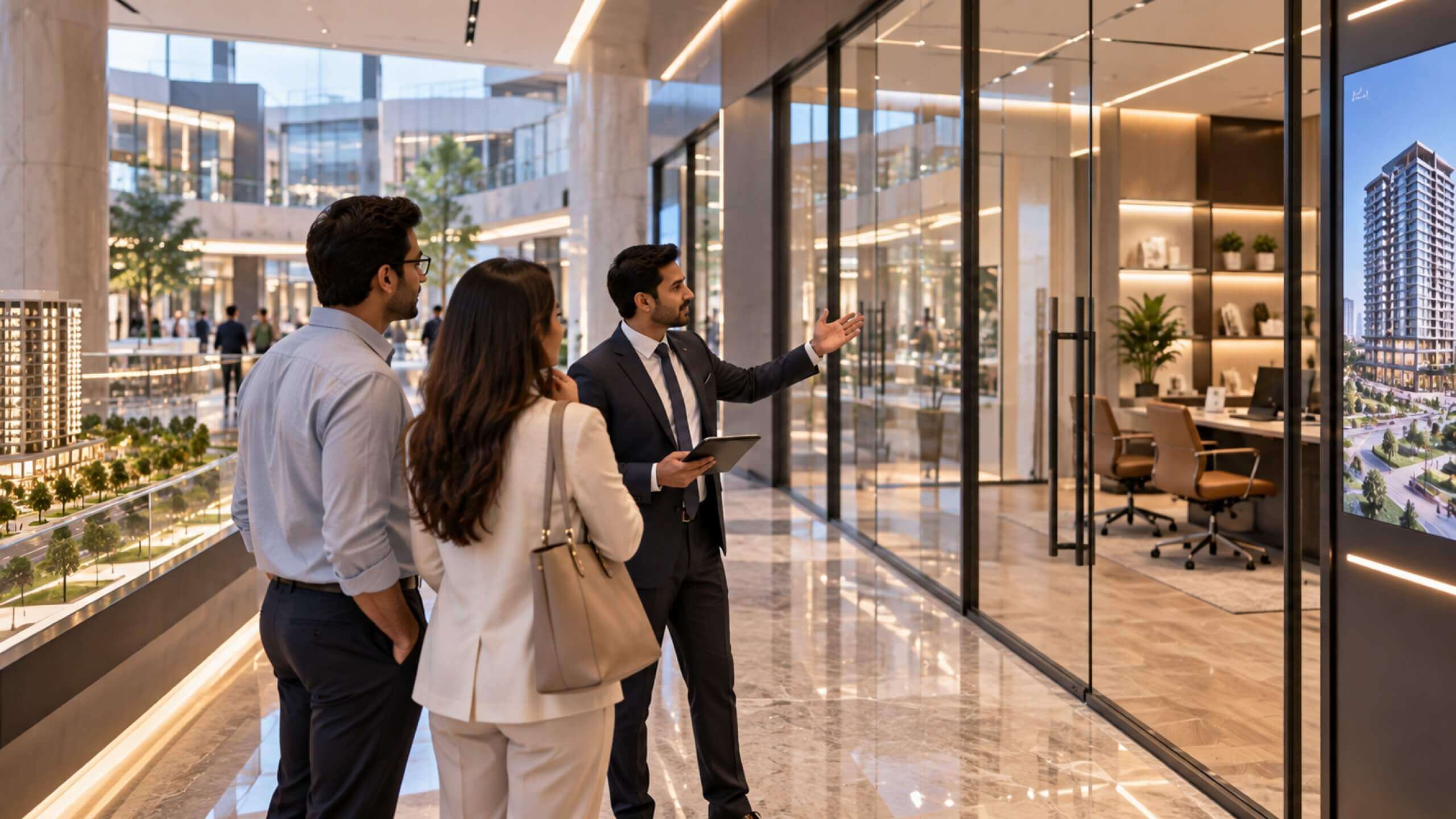
Commercial real estate covers a wide range of properties designed primarily for business, trade, services, accommodation, logistics and other income-generating activities. For investors, understanding these categories is important because each asset type has different users, operating requirements, leasing dynamics and risk factors.
For high-net-worth individuals, NRIs and commercial property investors, the question is therefore not simply where to invest, but what type of commercial real estate aligns with the investment objective.
What is Commercial Real Estate?
Commercial real estate refers to properties primarily used for business or commercial purposes rather than conventional residential occupation.
Common examples include:
- Office buildings and business parks
- Retail shops and shopping centres
- Hotels and hospitality properties
- Warehouses and logistics facilities
- Industrial properties
- Mixed-use developments
- Specialised commercial assets
The distinction matters because the economics of an office building can differ significantly from those of a retail shop, hotel or warehouse.
Major Types of Commercial Real Estate
While classifications can vary between markets, the following categories cover the principal forms of commercial property investors encounter.
| Type | Typical Use | Key Considerations |
|---|---|---|
| Office | Corporate offices, professional services, businesses | Tenant demand, accessibility, building quality |
| Retail | Shops, restaurants, stores and services | Footfall, visibility, catchment and tenant mix |
| Industrial | Manufacturing, production and industrial operations | Location, infrastructure and permitted use |
| Warehousing & Logistics | Storage, distribution and fulfilment | Connectivity, access and logistics infrastructure |
| Hospitality | Hotels, serviced accommodation and related uses | Location, occupancy, operator and management |
| Mixed-Use | Combination of commercial and residential uses | Integration, footfall and overall project planning |
1. Office Real Estate
Office property includes individual office units, corporate buildings, business parks and larger commercial complexes occupied by businesses and professional organisations.
Office demand is closely connected with employment centres, connectivity, infrastructure and the requirements of occupiers. Recent industry data also indicates continued institutional interest in India's office segment.
For investors, important factors include:
- Location and accessibility
- Quality and configuration of the building
- Tenant profile
- Lease structure
- Occupancy levels
- Parking and supporting amenities
For buyers researching office space in greater noida, these fundamentals are particularly important because the suitability of an office asset depends on the businesses it can practically serve.
2. Hospitality Real Estate
Hospitality real estate includes hotels, serviced accommodation and other properties designed to accommodate travellers and guests.
This category differs from conventional commercial property because performance depends not only on the physical asset but also on operations. Brand, operator capability, location, room demand and service standards can all influence the performance of a hospitality asset.
For hospitality investors, due diligence should therefore extend beyond the property itself to the proposed operating model, agreements, approvals and demand drivers.
3. Mixed-Use Commercial Real Estate
Mixed-use developments combine two or more property uses within an integrated development. These may include residential, retail, office, hospitality or entertainment components.
The model has become increasingly relevant in urban development because it can bring different user groups into the same ecosystem.
Levante Metro Walk, for example, is presented by Levante Group as a mixed-use development in Greater Noida comprising retail shops, studio apartments, food court spaces and multipurpose commercial areas.
For investors, mixed-use developments require a broader assessment. Instead of examining one asset in isolation, buyers should consider how residential activity, commercial uses, accessibility and project management interact.
4. Retail Real Estate
Retail real estate includes shops, high-street properties, shopping centres, food outlets and other spaces where businesses directly interact with consumers.
Unlike offices, retail properties are strongly influenced by customer movement and visibility. A well-designed retail space can still face challenges if the surrounding catchment does not generate sufficient demand.
Investors should therefore examine:
- Pedestrian and vehicular accessibility
- Visibility from major movement corridors
- Existing and planned catchment
- Tenant mix
- Parking and access
- Project management
- Competition from nearby retail destinations
This makes retail property particularly relevant for investors who understand the relationship between location, consumer behaviour and business activity.
5. Industrial Real Estate
Industrial real estate generally accommodates manufacturing, production, assembly and related industrial activities.
These properties are different from conventional offices or retail spaces because their requirements may include specialised layouts, loading facilities, utilities, storage areas and access for commercial vehicles.
Location is particularly important. Industrial occupiers often require efficient connections to highways, transport networks, suppliers and markets.
Investors considering industrial assets should verify the property's permitted use, infrastructure, physical specifications and potential occupier profile before making a purchase decision.
6. Warehousing and Logistics Real Estate
Warehouses are used for storing and distributing goods, while modern logistics facilities can support larger supply-chain operations.
The expansion of organised retail, e-commerce and manufacturing has increased institutional attention towards industrial and warehousing assets in India. IBEF reported that institutional investors remained focused on these segments in 2026, citing demand associated with e-commerce, manufacturing and logistics activity.
For warehouse investments, important considerations include:
- Highway and transport connectivity
- Loading and unloading infrastructure
- Floor specifications
- Storage capacity
- Access for commercial vehicles
- Proximity to consumption or production centres
Why Location Matters in Commercial Real Estate
Across almost every commercial asset class, location remains a fundamental consideration. However, “good location” does not mean the same thing for every property.
An office may need convenient employee and client access. A retail shop may depend more heavily on visibility and consumer movement. A warehouse may prioritise highway connectivity and vehicle access.
This is why investors exploring commercial projects in noida or Greater Noida should evaluate the property's intended use alongside the location rather than considering the location in isolation.
What Should HNWIs and NRIs Look For?
High-net-worth investors and NRIs may approach commercial real estate differently from an owner-occupier. The focus may extend beyond the physical property to portfolio strategy, income visibility, asset management and exit considerations.
A structured evaluation should include:
- Developer and project credentials
- Legal and regulatory due diligence
- Location and connectivity
- Tenant and occupier profile
- Leasing structure
- Maintenance and management arrangements
- Total acquisition cost
- Financing implications
- Exit and resale considerations
Projects such as Levante Metro Walk demonstrate how mixed-use developments can combine retail and other real estate formats within a single ecosystem. However, buyers should assess the specific unit, documentation and commercial fundamentals rather than relying solely on the broader project concept.
Conclusion
Understanding the types of commercial real estate is the first step towards making a more informed property decision. Office, retail, industrial, warehousing, hospitality and mixed-use assets serve different purposes and therefore require different investment analysis.
For investors exploring Greater Noida, the focus should remain on fundamentals: location, accessibility, intended use, occupier demand, project documentation and long-term ownership considerations.
Whether you are evaluating office space in greater noida, retail opportunities, or broader commercial projects in noida, informed due diligence can help you distinguish between a property that simply looks attractive and one that fits your investment strategy.
For buyers interested in exploring commercial and mixed-use opportunities, Levante Group offers developments, where retail, studio and multipurpose commercial spaces are brought together within a mixed-use format.