
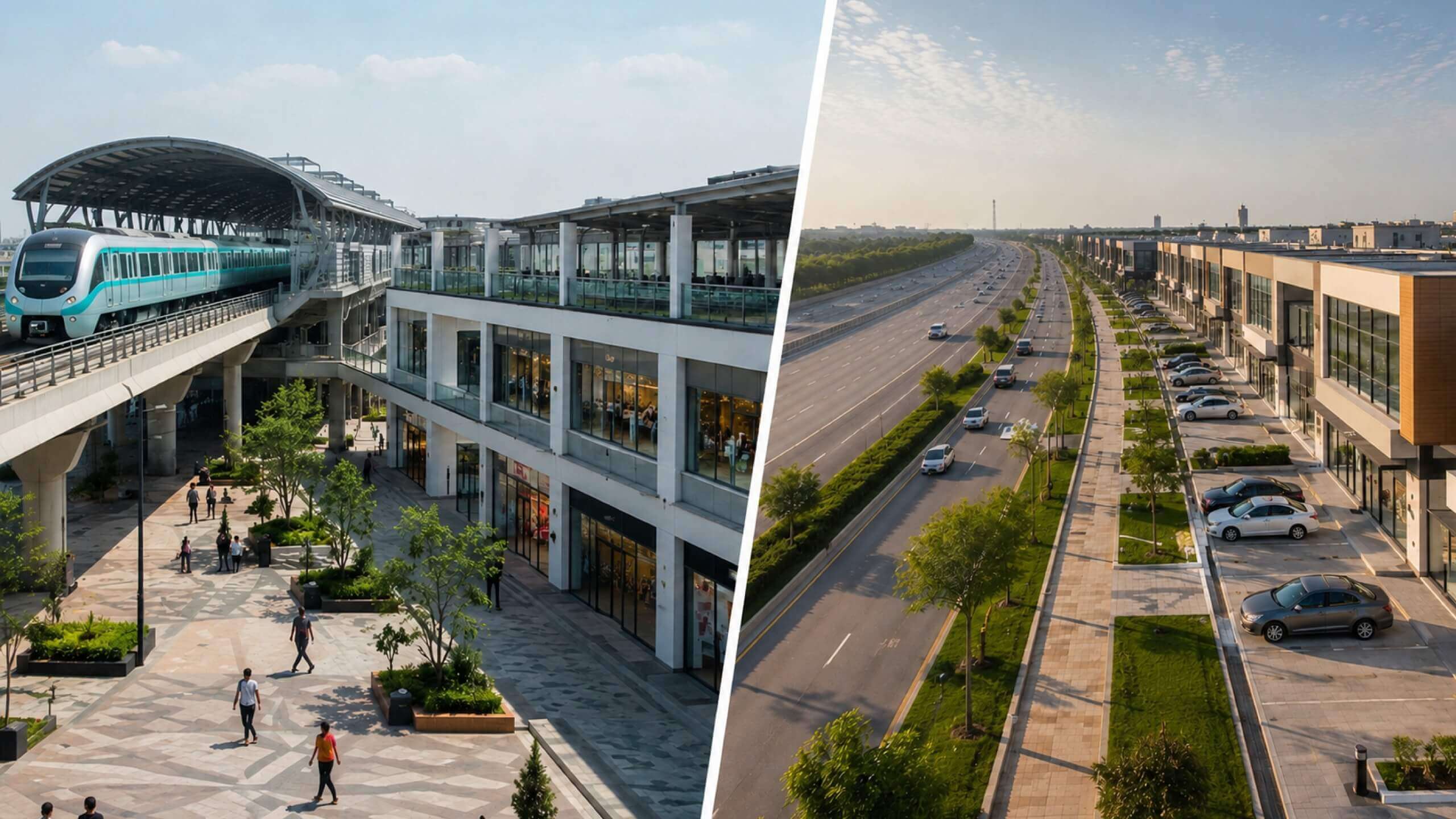
Choosing the right location is one of the most important decisions in retail real estate. A strategically placed shop can influence customer reach, daily footfall, business performance, and long-term investment value.
Retail shops near metro stations benefit from pedestrian movement, daily commuters, nearby residents, and office-goers. On the other hand, highway-facing commercial properties attract customers travelling by private vehicles, commercial transport, and long-distance routes.
For investors, business owners, and real estate professionals, the choice between metro-connected retail and highway retail depends on factors such as customer behaviour, business type, accessibility, parking needs, visibility, and future growth potential.
In developing markets like Greater Noida and the Yamuna Expressway region, where infrastructure expansion, residential growth, and improved connectivity are transforming commercial opportunities, understanding the difference between these locations has become increasingly important.
The better option depends on your business model, target customers, and how people access your property.
Metro vs Highway Retail: A Quick Comparison
| Factor | Retail Shops Near Metro Stations | Retail Shops Near Highway Locations |
|---|---|---|
| Primary customers | Commuters, residents, office workers, pedestrians | Travellers, motorists, local residents |
| Footfall | Supported by regular daily movement | Depends on accessibility and destination value |
| Visibility | Strong pedestrian visibility | Strong vehicle visibility |
| Parking | May be limited depending on location | Often a major requirement |
| Best suited for | Cafés, pharmacies, salons, convenience stores, daily-use services | Restaurants, automobile services, travel businesses |
| Customer visits | Frequent and short-duration | Planned or destination-based |
| Accessibility | Strong public transport connectivity | Strong private vehicle connectivity |
The comparison shows that there is no universally perfect retail location. The ideal choice depends on the nature of the business and customer expectations.
Why Retail Shops Near Metro Stations Are Attractive
Metro-connected retail spaces are gaining attention because of their accessibility, pedestrian movement, and integration with surrounding residential and commercial developments.
Transit-oriented development concepts encourage mixed-use growth around transport hubs, creating opportunities for retail, offices, housing, and public amenities within convenient reach.
Key Advantages of Metro Retail Locations
1. Strong Pedestrian Accessibility
Customers can easily reach businesses without depending entirely on private vehicles, making metro locations suitable for walk-in-driven businesses.
2. Regular Customer Movement
Businesses offering everyday products and services can benefit from repeat visits by commuters, residents, and nearby employees.
3. Convenience-Based Shopping Behaviour
Retail formats such as cafés, pharmacies, quick-service restaurants, salons, and convenience stores often perform well in locations where customers value speed and accessibility.
4. Mixed-Use Development Opportunities
Retail spaces surrounded by residential and office developments can benefit from multiple customer segments throughout the day.
However, being close to a metro station does not automatically guarantee success. Investors should evaluate actual walking distance, pedestrian pathways, visibility, signage, competition, parking availability, and surrounding development quality.
A property may appear nearby on a map but still be inconvenient if customers face difficult crossings, poor access routes, or limited visibility.
Why Retail Shops Near Highway Locations Can Be Attractive
Highway retail follows a different customer pattern. Instead of depending mainly on pedestrian movement, these properties serve customers travelling by cars, buses, commercial vehicles, and other modes of transport.
Highway-facing commercial spaces can be suitable for businesses that require visibility, larger areas, parking, and vehicle access.
Key Advantages of Highway Retail Locations
1. High Visibility from Passing Traffic
Properties located along major roads can benefit from exposure to a large number of travellers.
2. Wider Customer Reach
Highways connect multiple residential areas, cities, and commercial zones, allowing businesses to attract customers beyond the immediate locality.
3. Suitable for Vehicle-Oriented Businesses
Restaurants, automobile services, travel facilities, and large-format retail concepts may benefit from highway locations.
4. Better Parking Potential
Depending on site planning and regulations, highway developments may provide more space for vehicle movement and parking.
However, traffic volume alone does not guarantee retail success. Businesses must consider entry and exit points, signage, safe access, parking, service roads, and customer convenience.
A property with heavy traffic but poor accessibility may receive visibility without generating actual customers.
Metro or Highway: Which Location Is Better for Your Business?
The right choice depends on how your customers interact with your business.
Choose a Metro-Oriented Retail Location If:
- Your business depends on frequent walk-in customers.
- Customers make quick and regular purchases.
- Your target audience includes commuters, residents, or office workers.
- Public transport accessibility is important.
- Visibility from pedestrian movement can improve sales.
Suitable businesses include: cafés, convenience stores, pharmacies, salons, quick-service restaurants, and daily-use services.
Consider a Highway-Oriented Retail Location If:
- Customers primarily travel by private vehicles.
- Parking is an essential requirement.
- Your business needs larger spaces.
- You serve regional or travelling customers.
- Customers are willing to make planned stops.
Suitable businesses include: highway restaurants, automobile services, travel-related businesses, logistics facilities, and larger commercial concepts.
Conclusion: Selecting the Right Retail Location
The choice between retail shops near metro stations and highway locations depends on your business type, target customers, and investment goals. Metro locations are ideal for businesses seeking regular footfall and commuter-driven demand, while highway locations work well for businesses requiring vehicle access, parking, and wider customer reach.
For investors exploring opportunities in Greater Noida and the Yamuna Expressway region, factors such as connectivity, accessibility, infrastructure growth, and long-term demand should guide the decision.
Levante Group offers strategically planned commercial and residential developments designed to support evolving investment needs in high-growth locations.
Frequently Asked Questions
Are retail shops near metro stations a good investment?
Metro-connected retail spaces can be beneficial for businesses that depend on regular customer movement. Investors should evaluate accessibility, visibility, surrounding development, tenant demand, and pricing before making a decision.
Are retail shops near highways profitable?
Highway retail can perform well for businesses targeting motorists and travellers. Success depends on access, parking, visibility, regulations, and the suitability of the business model.
Which is better: metro-facing or highway-facing retail?
Neither option is universally better. Metro locations generally suit pedestrian-focused businesses, while highway locations are often better for vehicle-dependent and destination-based businesses.
Is Greater Noida a good location for commercial real estate?
Greater Noida offers a developing commercial environment supported by infrastructure growth and connectivity improvements. However, each property should be evaluated based on location, approvals, demand, and financial feasibility.