
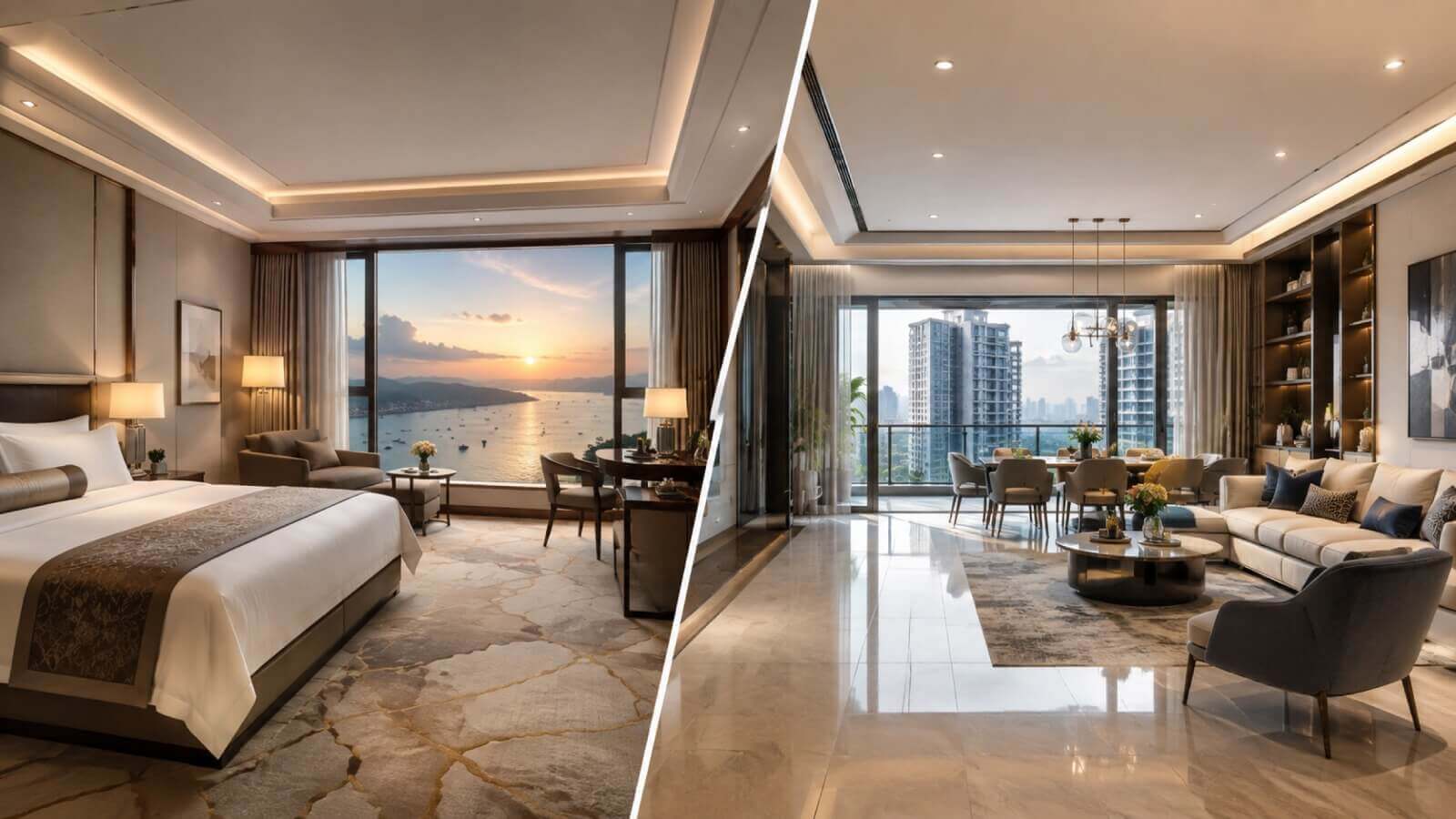
For high-net-worth individuals, NRIs and property investors, luxury real estate is no longer simply about owning a larger home. The more important question is how an asset performs as an investment, how much involvement it requires and what kind of demand supports it over time.
That choice between luxury hotel suites and luxury apartments is particularly relevant. Both can offer premium design, strategic locations and potential income opportunities, but they operate on fundamentally different models.
A luxury apartment is primarily a residential asset. A hotel suite operates within a hospitality ecosystem, where professional management, guest services and occupancy play a much greater role.
The right choice, therefore, depends less on which property looks more luxurious and more on what the investor wants ownership to achieve.
Luxury Hotel Suites vs Luxury Apartments: The Fundamental Difference
The distinction starts with the purpose of the asset.
A luxury apartment is designed primarily for private residential use. The owner typically controls how the property is occupied, furnished, leased or used, subject to the project's rules and applicable regulations.
A hotel suite, by contrast, is part of an accommodation business. India's Ministry of Tourism defines an apartment hotel as a hotel providing accommodation in rooms with additional space and facilities such as studios or apartments.
That difference creates two distinct ownership experiences.
| Factor | Luxury Hotel Suite | Luxury Apartment |
|---|---|---|
| Primary purpose | Hospitality accommodation | Residential living |
| Occupancy | Guests, often short-term | Owner or residential tenant |
| Operations | Professional hospitality management may handle operations | Owner or property manager typically handles leasing |
| Guest experience | Service-led | Privacy and residential comfort |
| Maintenance | Often integrated into hospitality operations | Owner/society-led, depending on project |
| Income model | Linked to hospitality operations and occupancy | Usually linked to rent or personal use |
| Owner involvement | Potentially lower when professionally managed | Generally higher when self-managed |
| Best suited to | Hospitality-oriented investors and hands-off ownership preferences | End-users and residential investors |
This comparison does not make one asset universally superior. It highlights the different economic and operational structures behind them.
Ownership Experience: Control vs Convenience
Luxury apartments generally provide greater control.
An owner can decide whether to occupy the property, lease it to a tenant, furnish it for a particular market or hold it for long-term appreciation. The asset remains closely connected to the owner's personal use and residential preferences.
Hotel suites offer a different proposition. Where professional hospitality management is part of the model, day-to-day activities such as guest servicing, housekeeping, front-office operations and room management can be handled within an organised operating structure.
India's Ministry of Tourism recognises that hotels may be managed either by the owning family or by professionals, underlining the operational importance of management in hospitality assets.
For an NRI or investor living outside the property's market, this distinction can be particularly important. The question is not simply what do I own? but also who operates the asset?
Guest Experience vs Residential Living
A luxury apartment is ultimately designed around the resident.
Its value comes from factors such as privacy, floor plan, views, community infrastructure, location, construction quality and the overall residential environment.
A hotel suite is designed around the guest journey.
The experience can involve reception, housekeeping, food and beverage, concierge-style services, common facilities and professionally managed spaces. India's official accommodation framework recognises hotels as accommodation units that can include reception, lodging, food and beverage and ancillary services.
This creates a fundamentally different proposition.
Luxury apartments sell a private lifestyle. Luxury hotel suites sell an operated hospitality experience.
Hospitality Management Changes the Investment Equation
This is arguably the most important distinction for investors evaluating luxury hotel suites or luxury apartments.
A residential property can generate rental income, but the owner generally remains responsible for finding tenants, managing leases, coordinating repairs, and responding to operational issues unless a property manager handles those responsibilities.
A professionally operated hospitality asset introduces another layer: the operator becomes responsible for delivering the guest experience and running the property as a hospitality business.
That can reduce the owner's operational involvement, but it also means the investment depends on the quality of the management structure.
Before investing, buyers should examine:
- Who operates the property?
- What services does the operator provide?
- How are operating expenses allocated?
- What are the owner's usage rights?
- How are revenues and expenses accounted for?
- What happens if the management agreement changes or ends?
- What restrictions apply to resale, leasing or personal use?
These questions are more meaningful than simply comparing the advertised price per square foot.
What Creates Long-Term Value?
Long-term value in either asset class depends on several variables rather than one headline feature.
1. Location and Connectivity
Location remains foundational for both formats.
For apartments, proximity to employment centres, education, healthcare, retail and transport can influence residential demand.
For hospitality assets, demand generators can include business districts, tourism, events, airports, institutions and emerging commercial corridors.
The location must therefore be evaluated according to the property's actual use case.
2. Quality of Operations
A luxury hotel suite can have an impressive specification, but the hospitality operation determines much of the guest experience.
Service standards, housekeeping, maintenance, food and beverage operations and reputation can influence the property's competitiveness.
This is why operational hotels rely on standards covering facilities and services rather than treating physical design alone as the measure of hotel quality.
3. Asset Quality and Positioning
For luxury apartments, construction quality, architecture, amenities, privacy and the surrounding neighbourhood influence buyer and tenant appeal.
For hotel suites, the proposition also needs to remain competitive with other accommodation choices.
The strongest long-term asset is therefore not necessarily the one with the most amenities. It is the one whose location, design, operations and target market remain relevant.
4. Demand Depth
Investors should distinguish between potential demand and proven demand.
Residential demand can be assessed through comparable rents, resale activity, employment ecosystems and absorption in the surrounding market.
Hospitality demand requires a different lens, including the area's visitor profile, competing hotels, room supply, occupancy trends and the strength of the operating concept.
Industry research continues to highlight changing travel patterns, experiential demand and the importance of coordinated hotel operations in India's hospitality market.
Luxury Hotel Suites vs Luxury Apartments: The Verdict
The better long-term asset depends on the investor's objective.
A luxury apartment generally offers greater control, residential flexibility and a familiar ownership structure. A luxury hotel suite introduces hospitality operations, service-led guest experiences and a potentially more hands-off ownership model, but also brings greater dependence on professional management and operating performance.
The real question is not which property is more luxurious? It is which operating and ownership model best matches the investor's objectives, risk tolerance and expected involvement.
For sophisticated buyers, that distinction matters. Whether evaluating a hospitality-led asset, a residential investment or a mixed-use opportunity in Greater Noida, long-term value should be assessed through ownership structure, location, demand, asset quality and operational fundamentals, not promises of returns.
Frequently Asked Questions
Are luxury hotel suites better investments than luxury apartments?
Not universally. Hotel suites and apartments have different ownership and operating models. The appropriate choice depends on investment objectives, management structure, usage rights, costs and market demand.
What is the main difference between a hotel suite and a luxury apartment?
A hotel suite operates within a hospitality model designed for guests and services, while a luxury apartment primarily serves residential occupants and provides greater control over personal use and leasing.
Can luxury hotel suites generate rental income?
A hospitality asset may generate income through its operating model, but actual revenue depends on occupancy, room rates, expenses, management and market conditions.